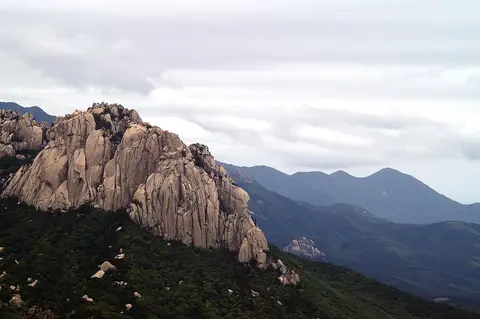
A port city on the East Sea where you can enjoy both the sea and Seoraksan National Park, which in 1982 became Korea's first UNESCO Biosphere Reserve. Abai Village and its gaetbae ferry, built by refugees from Hamgyeong Province, and seaside spots like Yeonggeumjeong and Daepo Port are close to the centre, and the city is known for refugee dishes such as squid sundae and abai sundae.
Seoraksan has something to see all year: azaleas in spring, fresh green in summer, autumn leaves and winter snow. In October a red snow crab festival is sometimes held alongside the Seorak autumn colours. Swimming is allowed only during each beach's official season; in 2026 Sokcho Beach was open 3 July–23 August. Dates change every year, so check the city tourism site.
Getting there
Express bus (Sokcho Express Bus Terminal)
Sokcho Express Bus Terminal has routes to Seoul (Gangnam), Dong Seoul, Incheon, Gwangmyeong and Cheolsan. Korea Tourism Organization says buses to Sokcho leave from both Seoul Express Bus Terminal and Dong Seoul Terminal. The terminal is a 5-minute walk from Sokcho Beach. Book at kobus.co.kr.
Time Sokcho City: Seoul (Gangnam) in 2-plus hoursCost check official info (booking site)
Intercity bus (Sokcho Intercity Bus Terminal)
Sokcho Intercity Bus Terminal has routes to major cities across Korea. Buses to Dong Seoul Terminal take about 2 hours 10 minutes via the Misiryeong Tunnel and the Seoul–Chuncheon Expressway. Buses to Daegu and Busan go via Gangneung, Donghae and Pohang. Express and intercity buses to the same place may use different terminals, so check txbus.t-money.co.kr.
Time Dong Seoul about 2 hr 10 minCost check official info (booking site)
Yangyang International Airport → Sokcho
Korea Tourism Organization says intercity buses to Gangneung and Sokcho leave from outside Gates 2 and 3 on the airport's 2nd floor. Buses don't accept international credit cards, so have a transit card or cash (some routes don't take cash). The taxi stand is outside Gate 4 on the 1st floor (information as of 22 May 2026).
Time about 30 min by taxiCost check official info
Getting around
City buses (Nos. 7 and 7-1 to Seoraksan)
For Seoraksan, take bus 7 or 7-1. It starts at the Intercity Bus Terminal and runs via the Express Bus Terminal, the Seoraksan entrance and the Seoraksan National Park visitor centre to the Seoraksan car park at the end of the line. Routes and timetables can be downloaded from the transport page of the city tourism site, and there is a free public transport helpline (080-850-9486, weekdays 09:30–17:30).
Gaetbae ferry (city ↔ Abai Village)
This boat crosses the channel between central Sokcho and Abai Village in Cheongho-dong. It runs 05:00–23:00 from May to October and 05:30–22:30 from November to April (may change with the weather). One way costs KRW 500 for adults and KRW 300 for children (primary school).
On foot
Sokcho Beach is a 5-minute walk from the Express Bus Terminal, and the Lighthouse Observatory is about a 10-minute walk from Yeonggeumjeong. Sokcho Beach and Cheongchoho Lake Park are near Abai Village, so they are easy to combine on foot.
The starting point for Seoraksan hikes and the Gwongeumseong cable car. Sokcho City says spots like Ulsanbawi, Heundeulbawi and Biryong Falls are best reached from Sokcho via Sogongwon. There is no cable car car park; drivers use the paid Sinheungsa car park.
City centre and Sokcho Port (Tourist & Fishery Market, Abai Village, Yeonggeumjeong)
Good for: Market food, refugee village, sunrise
Sokcho Tourist & Fishery Market has 5 alleys: fruit and vegetables, chilli, sundae, salted seafood and fish, and fried chicken (the basement raw fish centre closes on the 2nd Wednesday of the month). Abai Village is a gaetbae ride away, and Yeonggeumjeong, Dongmyeong Port and Cheongchoho Lake are close.
Sokcho Beach and Daepo Port (south coast)
Good for: Beach walks, raw fish and fried snacks
Sokcho Beach is a 5-minute walk from the Express Bus Terminal and its sand stretches 940 m. To the south, Daepo Port has live fish stalls and a fried food alley, and the Daepo Port Observatory on the hill behind looks over the sea and Ulsanbawi.
Designated a Natural Monument in 1965 and Korea's fifth national park in 1970, it became a UNESCO Biosphere Reserve in 1982. The name 'Seorak' is said to come from the main peak, Daecheongbong (1,708 m), being covered in snow 5–6 months a year. The Sokcho side is called Oeseorak (Outer Seorak). Sokcho City lists admission as free.
Sinheungsa Temple
A temple on the way from Seoraksan's Sogongwon to the Biseondae and Heundeulbawi trails. It traces back to Hyangseongsa, founded in 652; in 1644 three monks are said to have had the same dream and built the temple on its present site, naming it Sinheungsa. Highlights are the Bojeru pavilion, a textbook of late Joseon architecture, and Geungnakbojeon Hall with its Amitabha triad.
The cable car runs about 1.2 km from Sogongwon up to Gwongeumseong at about 700 m, taking 5 minutes each way. Gwongeumseong is a fortress said to have been built overnight by two generals, Kwon and Kim, during the Mongol invasion of 1253; only its site remains. From the top you can see Ulsanbawi and the East Sea. Return tickets cost KRW 16,000 for adults and KRW 12,000 for children and are sold only on the day, on site.
Biseondae and Heundeulbawi trails
Easy Seoraksan routes recommended by Sokcho City for beginners. The Biseondae route runs Sogongwon–Sinheungsa–Waseondae–Biseondae, 3.0 km one way (about 1 hr 20 min); the Heundeulbawi route runs Sogongwon–Sinheungsa–Naewonam–Heundeulbawi, 2.8 km one way (about 1 hr). The Heundeulbawi route heads in the direction of Ulsanbawi.
Yeonggeumjeong
Where a ridge of Seoraksan meets the sea; the name comes from the sound of waves hitting the rocks, said to be like a geomungo (Korean zither). A pavilion stands at the end of a footbridge over the rocks and is a popular spot for sunrise and sunset. The Lighthouse Observatory is about a 10-minute walk away. Always open.
Abai Village and the Gaetbae
A village built on a sandbar by refugees from Hamgyeong Province who fled during the Korean War in 1950. 'Abai' is Hamgyeong dialect for an older man. You cross from the city on the gaetbae, a boat moved by hooking onto a steel cable and pulling it by hand. The village is open 24 hours.
Daepo Port
Unlike Sokcho Port, used by large fishing boats, Daepo is a port for small boats. Live fish stalls and raw fish restaurants line about 500 m of the approach road (10:00–23:00), and a fried food alley sells fried shrimp, squid and squid sundae. The Daepo Port Observatory on the hill behind is a sunrise spot.
Cheongchoho Lake and Yeongnangho Lake
Cheongchoho is a lagoon 5 km around at the heart of the city, with a lakeside park that hosted the 1999 Gangwon International Tourism Expo. To the north, Yeongnangho is a natural lake 7.8 km around; legend says the Silla hwarang Yeongnang lingered here, taken by the view. It has Beombawi (Tiger Rock) and a wetland eco park. Both are always open and free.
A whole squid stuffed with sticky rice, radish greens, carrot, onion and perilla leaves, then steamed. It is said to have started because pork intestines were hard to find. Eat it dipped in mustard and chilli sauce.
Abai sundae
A Hamgyeong-style sundae of pork large intestine filled with blood, sticky rice, dried cabbage leaves and bean sprouts, then steamed. As the name suggests, it is big and hearty. Refugee-style restaurants cluster in Abai Village.
Hamheung naengmyeon and makguksu
Hamheung naengmyeon was made known by refugees from Hamgyeong Province: thin, chewy noodles topped with spicy seasoned raw pollack. Makguksu is buckwheat noodles that break easily, with a nutty buckwheat flavour.
Mulhoe (cold raw fish soup)
A summer favourite made from fresh live fish and served with ice. You can try it wherever live fish is sold: Seorak, Daepo, Dongmyeong and Jangsa ports, the Abai Village raw fish centre and Sokcho Tourist & Fishery Market.
Saengseon gui (grilled fish)
Grilled fish restaurants cluster around Abai Village and the gaetbae. Five or six kinds of fish, such as Spanish mackerel, saury, mackerel, sand lance and sandfish, are grilled whole or in pieces.
Dakgangjeong (sweet crispy fried chicken)
Dakgangjeong shops gather in the fried chicken alley of Sokcho Tourist & Fishery Market. Each shop fries a little differently and uses different ingredients, so it's fun to compare.
Daily budget (per person)
BudgetSeoraksan National Park (per Sokcho City), Yeonggeumjeong, Abai Village, Sokcho Beach and Cheongchoho and Yeongnangho lakes are free. The gaetbae is KRW 500 one way for adults. Hotel and food costs vary by date; check booking sites
Mid-rangeAdding the Seorak Cable Car: KRW 16,000 return for adults, KRW 12,000 for children. Check bus fares on the booking sites and hotels and food on booking sites
ComfortAccommodation is most of the budget — for the summer holidays and the autumn leaf season, compare prices for your dates on booking sites early
Amounts are rough figures in local currency. Check exchange rates before you go.
Sample itinerary
Day 1
Arrive in Sokcho by bus → city bus 7 or 7-1 to Seoraksan Sogongwon → cable car to Gwongeumseong → Sinheungsa → walk the Biseondae route → back to the city for dinner at Sokcho Tourist & Fishery Market.
Day 2
Sunrise at Yeonggeumjeong → gaetbae to Abai Village (abai sundae, squid sundae) → Cheongchoho Lake Park → Sokcho Beach → raw fish or fried snacks at Daepo Port → bus home.
Local tips
Some Seoraksan trails close during restricted-entry periods. Check closures on the Korea National Park Service site (knps.or.kr) before you go.
The Seorak Cable Car takes no reservations; tickets are sold only on the day, on site. Only return tickets are sold and there is no hiking trail down from Gwongeumseong. Service may stop in strong wind or bad weather.
Swimming is allowed only during each beach's official season. In 2026 swimming hours at Sokcho Beach were 09:00–18:00.
Buses at Yangyang International Airport don't accept international credit cards. Have a transit card or cash.
Tourist information centres (Haemaji, Intercity Bus Terminal, Express Bus Terminal, Tourist & Fishery Market) are open 09:00–18:00 with a break 12:00–13:00. The tourist helpline is 1330. Fees and opening hours can change, so check official information before you go.
Entry rules for Korea depend on your nationality. Check official Korean government information before you travel.