Korean MOFA travel advisory: Your destination: no advisory · some areas of the country have advisories

Elsewhere in the country: Level 3 (leave the country) — some regions: L3 (leave): within 30 km of Fukushima Daiichi NPP and government-designated evacuation zones / rest of Japan: no advisory

Visits to the listed regions should be cancelled or postponed (see Details for other areas).

checked 2026-10-05 · Details ↗ This is the Korean government’s advisory — also check your own government’s travel advice.

Ishigaki Travel Guide

The main island of the Yaeyama Islands, about 410 km southwest of Naha on Okinawa Island (about an hour's flight from Naha Airport). It is known for coral seas, Kabira Bay, a national Place of Scenic Beauty, and star-filled night skies, and ferries to Taketomi and Iriomote leave from the island port terminal in town.

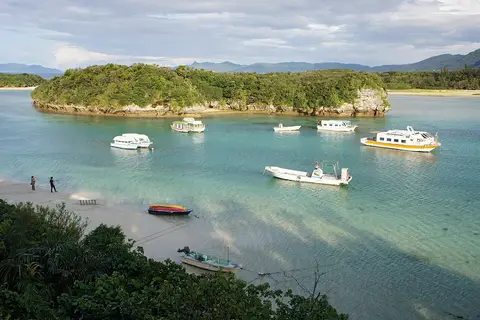
The emerald water of Kabira Bay on Ishigaki Island, dotted with small islands.
Kabira Bay · Photo: 663highland / CC BY-SA 3.0

Plan your Ishigaki trip

We never take payment — compare, then book on the official partner site.

At a glance

Currency
JPY (¥)
Power & plugs
100V · Type A/B
Driving side
Left
Tipping
Not expected
Local language
日本語
How long to stay
3 to 4 days (including island day trips)

Emergency numbers

When to go

A subtropical island with an average yearly temperature of 24.3°C. Beaches open in March, the earliest in Japan, and the rainy season starts early and ends around early June. July-August has the most beautiful seas, but typhoons often approach from late June to October, peaking in September-October. In January-February the north wind makes it feel cooler, so bring a jacket.

Monthly climate normals

High °CLow °CRain mm
Jan21.5°16.7°135.0
Feb22.0°17.2°124.0
Mar23.7°18.6°134.4
Apr26.0°21.3°146.9
May28.7°23.9°190.7
Jun30.9°26.6°208.2
Jul32.2°27.7°142.3
Aug32.0°27.3°249.8
Sep31.0°26.0°259.7
Oct28.8°23.9°211.2
Nov26.2°21.5°138.1
Dec23.0°18.4°155.2

Monthly averages of daily highs and lows, and average monthly rainfall. Any given year can differ.

Source: Japan Meteorological Agency · Ishigakijima station · 1991–2020 normals —View source

Airport to the city

Direct and route buses (airport to port terminal / bus terminal)

From the airport bus stop, take a bus toward the Ishigaki Port island terminal and the bus terminal in town. The direct bus runs roughly every 30 minutes during the day. Pay in cash or with a contactless credit card; transport IC cards are not accepted. Direct route 14, still listed on the airport site, is suspended from 1 October 2026.

Time about 45 min (varies by route)Cost JPY 550 one way (airport-port terminal return ticket JPY 1,000)

Taxi

The taxi stand is in front of the arrivals lobby. Times and fares below are the airport's estimates for a standard taxi and vary with route and traffic.

Time about 25 min to the port terminal, about 20 min to City HallCost about JPY 3,500 to the port terminal, about JPY 2,800 to City Hall

Rental car

Rental company shuttle pick-up points are inside the airport's general car park. Check pick-up details with your rental company. Most of the island is within an hour's drive.

Time about 30 min by car to Kabira BayCost varies by company, car and season

Route bus to Kabira

Only two buses a day go straight from the airport toward Kabira Park (leaving the airport at 12:15 and 15:00). At other times, change at the bus terminal in town.

Time about 40 minCost check official fares

Getting around

Rental car

The easiest way to explore Ishigaki. Japan drives on the left, and foreign licenses usually require an International Driving Permit; check official rules before you go. Crested serpent eagles, a protected special natural monument, keep getting hit by cars, so drive slowly.

Route buses

Buses run from the bus terminal in town across the island. Pay in cash or by contactless credit card only; transport IC cards are not accepted. A 24-hour pass costs JPY 1,000 and a 3-day pass JPY 2,000. Buses stop running when a storm warning is issued for the Yaeyama area.

Taxis

Handy for short trips in town. From the airport to Hirakubo-zaki at the northern tip is about 45 min and about JPY 7,100.

Ferries (port terminal)

High-speed boats to Taketomi, Iriomote and other islands leave from the Ishigaki Port island terminal, run by two companies. The Ishigaki counters take cash, cards, e-money, transport IC cards and QR payments, but small ports such as Taketomi take cash only. Sailings are cancelled in rough seas, so keep your plans flexible.

Bicycle (Taketomi)

Cycling is the main way to get around Taketomi, which has several bicycle rental shops. Buffalo-cart tour operators and bike rental shops run free shuttles between the port and the village.

Where to stay

Town center and port terminal

Good for: First visit, island hopping, car-free trips

The island's hub, with hotels, restaurants and souvenir shops. Ferries to the outer islands and route buses all start here, so getting around is easy.

Kabira and the northwest coast

Good for: Sea views, snorkeling, families

Home to Kabira Bay and the Yonehara coast. Nearby Sukuji Beach has very shallow water and a sandy bottom, good for young children, with jellyfish nets in summer.

Hirakubo Peninsula (northeast)

Good for: Drives, viewpoints, quiet beaches

A long, sparsely populated peninsula in the northeast with fine beaches and hiking trails, plus Tamatorizaki Observatory and Hirakubo-zaki.

Map of stays in Ishigaki

Compare prices from many booking sites on the map

Search stays in Ishigaki in the app

Map & prices: Stay22 — you book on each site

Top sights

  1. Kabira Bay

    Ishigaki's signature view, a national Place of Scenic Beauty with three stars in the Michelin Green Guide. Swimming is not allowed because of black pearl farming. Instead, glass-bottom boats leave every 15 or 30 minutes without reservations, and the lookout at Kabira Park shows the whole bay. The car park gets busy, so check the city's YouTube live camera first.

  2. Taketomi Island

    10-15 min by high-speed boat from the port terminal. The village of red-tiled roofs, coral stone walls and white sand lanes is a national Preservation District for Groups of Traditional Buildings. Try a 30-minute buffalo-cart tour, then Kondoi Beach, a 15-minute walk from the village, or sunset at the West Pier. The boat costs JPY 970 one way.

    White sand and clear shallow water at Kondoi Beach on Taketomi Island.
    Kondoi Beach, Taketomi Island · Photo: ajari from Japan / CC BY 2.0
  3. Iriomote Island

    The largest of the Yaeyama Islands; over 90% of it is jungle and about 70% is a World Natural Heritage site. High-speed boats take 35-40 min to Ohara Port (JPY 2,520 one way) and 40-50 min to Uehara Port (JPY 3,290). Allow 1-2 hours for a river cruise and a full day for trekking or kayaking tours. Beaches have no lifeguards or jellyfish nets.

  4. Tamatorizaki Observatory

    A lookout over the Hirakubo Peninsula and the sea, with Ibaruma Bay on the left, Mt. Hanna ahead and coral reefs on the right. Hibiscus blooms year-round along the path up. About 20 min by car from the airport.

    The Hirakubo Peninsula and coral-reef sea seen from Tamatorizaki.
    Tamatorizaki Observatory · Photo: Kzaral / CC BY 2.0
  5. Hirakubo-zaki

    The cape at the northern tip of the Hirakubo Peninsula. From the lighthouse, the Pacific Ocean spreads out on the right and the East China Sea on the left. About 45 min by taxi from the airport.

  6. Ishigaki City Yaeyama Museum

    The city museum collecting and showing Yaeyama history, folklore, art and crafts. Open 9:00-17:00 (last entry 16:30); closed Mondays, national holidays and December 29-January 3. Adults JPY 200, students JPY 100, 12 and under free; free parking.

  7. Yonehara coast

    A coast inside Iriomote-Ishigaki National Park and a good snorkeling spot. However, there are no lifeguards or jellyfish nets, and the currents are strong. Don't step on or take coral, and don't feed the fish.

  8. Starry night skies

    Iriomote-Ishigaki National Park was the first place in Japan recognized by DarkSky International as a Dark Sky Place (starry sky reserve). You can see 84 of the 88 constellations, including the Southern Cross.

Tours & tickets →

What to eat

Yaeyama soba

The Yaeyama style of Okinawa soba, made with wheat flour rather than buckwheat. Slightly thin round noodles come with toppings cut into strips in a gently sweet broth. It goes well with pipatsu, a pepper-like local spice.

Ishigaki beef

Ishigaki Island's brand of Kuroge Wagyu beef, raised in a nature-rich, low-stress environment. Known for clean, high-quality fat and rich flavor.

Local fish dishes

The waters around Ishigaki are full of fish, usually eaten as sashimi, maasu-ni (simmered in salt) or tempura. Locally caught bluefin tuna and skipjack are especially good.

Tropical fruit

Very sweet pineapple and mango are Ishigaki's signature southern fruits.

Daily budget (per person)

BudgetAirport-port terminal bus JPY 550 one way (return ticket JPY 1,000), 24-hour bus pass JPY 1,000, Yaeyama Museum JPY 200. Hotel and food costs vary by date; check booking sites
Mid-rangeAdding island trips: Taketomi return JPY 1,880, Iriomote return JPY 4,880 to Ohara Port or JPY 6,370 to Uehara Port (fuel surcharge included, may change). Check rental car prices by company and season
ComfortTaxi estimates: airport to Kabira Park about 40 min, about JPY 5,600; to Hirakubo-zaki about 45 min, about JPY 7,100. From 1 February 2027 an accommodation tax applies (2% of the room rate per person per night, up to JPY 2,000). Compare hotel prices on booking sites

Amounts are rough figures in local currency. Check exchange rates before you go.

Sample itinerary

  1. Day 1

    Pick up your rental car, ride a glass-bottom boat at Kabira Bay, look around the Yonehara coast, then Tamatorizaki Observatory and Hirakubo-zaki in the afternoon. Stargazing at night.

  2. Day 2

    Morning boat to Taketomi Island (bicycle, buffalo cart, Kondoi Beach), back to Ishigaki in the afternoon for the Yaeyama Museum (closed Mondays, last entry 16:30), then dinner in town.

Local tips

Related articles

All articles →

Prices and times are approximate as of 2026-09 and may change. Always re-check visa and entry rules with official sources before you travel.

More city guides