An East Sea coastal city with Gyeongpodae Pavilion and Gyeongpo Lake, long sandy beaches, Ojukheon (birthplace of the scholar Yulgok) and Seongyojang, a noble family house kept in its original form for some 300 years. It is about 2 hours from Seoul Station by KTX and is known for the UNESCO-listed Gangneung Danoje Festival and local dishes like chodang tofu and gamja ongsimi.
In spring a cherry blossom festival is held around Gyeongpodae and Gyeongpo Lake. Swimming is allowed only during each beach's official summer season. The Gangneung Danoje Festival runs for about a week around the 5th day of the 5th lunar month, and the Gangneung Coffee Festival runs 21–25 October 2026. Dates change every year, so check the city tourism site.
Getting there
KTX Gangneung Line (Gangneung Station)
The KTX Gangneung Line runs 237.7 km from Cheongnyangni Station in Seoul to Gangneung Station, and trains also start from Seoul Station. Korea Tourism Organization puts Seoul Station to Gangneung Station at about 2 hours. Gangneung Station is in Gyo-dong in the city centre. Check timetables and fares on Korail (letskorail.com).
Time Seoul Station about 2 hrCost check official info (Korail)
Express and intercity buses
Buses to Gangneung leave from Seoul Express Bus Terminal and Dong Seoul Terminal, and intercity buses to Gangneung (Jumunjin) leave from Seoul Nambu Terminal. Express and intercity buses to the same place may use different terminals. Book express buses at kobus.co.kr and intercity buses at bustago.or.kr or txbus.t-money.co.kr.
Time Gangneung City gives about 3 hr by bus from Seoul to Gangneung City HallCost check official info (booking site)
KTX-Eum Donghae Line (Bujeon, Busan → Gangneung)
Since 30 December 2025 KTX-Eum trains run the whole Donghae Line. There are 6 trains a day between Bujeon and Gangneung (3 each way), stopping at Gyeongju, Pohang, Jeongdongjin and other stations. Weekends and the summer holidays sell out fast, so book ahead on the Korail Talk app.
Time Bujeon about 3 hr 50 min; Jeongdongjin → Gangneung about 14 minCost check official info (Korail)
Yangyang International Airport → Gangneung
Korea Tourism Organization says a free shuttle bus to Yangyang Terminal and Gangneung Station, and intercity buses to Gangneung, leave from outside Gates 2 and 3 on the airport's 2nd floor. Buses don't accept international credit cards, so have a transit card or cash. The taxi stand is outside Gate 4 on the 1st floor.
Time about 45 min by taxiCost shuttle free; intercity bus: check official info
Getting around
City buses
Regular buses cost KRW 1,530 by transit card (KRW 1,700 cash); seat buses KRW 2,160 by card (KRW 2,400 cash). With a card you get up to 2 free transfers within 1 hour of getting off (not onto the same route number; tap your card when you get off). Routes and real-time arrivals are on the Gangneung bus information system (bis.gn.go.kr).
City (SEA TEA) Bus
Runs about 23 km along the coast from Anmok Beach via Songjeong, Gangmun, Gyeongpo, Sacheonjin, Yeongok, Yeongjin Port and Jumunjin Fish Market to Jumunjin Beach. Gangneung City says it runs daily from 08:00 every 40 minutes at the normal city bus fare, with transfers to city buses. Service can change during events, so check notices on the bus information system.
From Gangneung Station to Anmok and Gyeongpo
Anmok Beach is about 15 minutes from Gangneung Station by city bus (Nos. 300-1, 223-1, 225-1, 314-1) or taxi. Route numbers can change, so check the bus information system or the Gangneung Station tourist information centre (033-642-8692).
Transit cards and autonomous tourist vehicles
Nationwide transit cards such as T-money work here (except the Climate Card). Free self-driving tourist vehicles link major sights; reserve on the day and board with a QR mobile ticket.
Where to stay
Gyeongpo (Gyeongpodae, Gyeongpo Lake and Beach, Chodang)
Good for: Beach and lake walks, chodang tofu
Gyeongpo Lake is about 6 km north of the city centre, and Gyeongpo Beach is 1 km from Gyeongpodae. Chodang Tofu Village and Gangmun Beach are close by. The Gyeongpo tourist information centre is open 09:00–18:00.
City centre (Gangneung Station, bus terminal, Seongyojang, Ojukheon)
Good for: Easy train and bus access, historic houses
Gangneung Station is in Gyo-dong, and there are tourist information centres at the station and the bus terminal (09:00–18:00). Ojukheon and Gyeongpodae are near Seongyojang, so the three fit into one day.
Jeongdongjin and Jumunjin (south and north coast)
Good for: Sunrise, harbour and fish market
Jeongdongjin is about 18 km south of the city along the coast, with the sea right in front of Jeongdongjin Station. Jumunjin in the north, near the end of the City Bus route, has Jumunjin Port and its fish market.
A pavilion designated as national heritage and one of Gangneung's best-known scenic spots. It is said to have been first built in the 13th year of King Chungsuk of Goryeo, and it holds writings by many notable figures, including 'Gyeongpodaebu', said to have been written by Yulgok Yi I at age 10. From its raised site you can see Gyeongpo Lake and the sea. Open all year, free.
Gyeongpo Lake is a lagoon separated from the sea by a sandbar; it is now about 4 km around and known for its old pines and cherry trees. Next to it, Gyeongpo Beach is called the largest beach on the east coast, with 1.8 km of white sand backed by 4 km of pine forest. Both are open at all times and free (showers KRW 3,500 in swimming season).
Ojukheon House
Where the scholar Yulgok Yi I and his mother, Shin Saimdang, were born. Built in the early Joseon period, it was designated a Treasure in 1963. Mongryongsil (the room where Yulgok was born), Yulgok Memorial Hall and Gangneung Municipal Museum are on site. 09:00–18:00 (last entry 17:00); adults KRW 3,000, free for 65 and over.
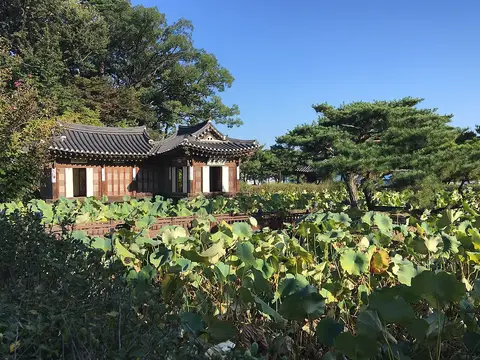
A 99-kan upper-class house first lived in by Yi Nae-beon of a leading Gangneung family and passed down through his descendants; designated national heritage, it has kept its original form for some 300 years. Highlights are the Yeolhwadang men's quarters and the Hwallaejeong pavilion over a pond. 09:00–18:00 March–October, 09:00–17:00 November–February; closed Seollal and Chuseok; adults KRW 5,000.
Anmok Beach Coffee Street
Cafés line the seafront here, earning it the name Gangneung Coffee Street. It grew from a row of roadside coffee vending machines and now has about 30 coffee shops. The Gangneung Coffee Festival is held in autumn. The beach is always open and free.
Jeongdongjin
The name means a ferry village due east of Gwanghwamun in Hanyang (old Seoul), and it is a famous New Year sunrise spot. Jeongdongjin Station is in the Guinness book as the train station closest to the sea in the world, and the beach is about a 3-minute walk away. The Jeongdongsimgok Badabuchae Trail (3.01 km) along the coastal terraces is nearby.
Jumunjin Port
A major east coast fishing port used by about 350 fishing boats, with large catches of squid, sand lance, pollack, herring and anchovy. Nearby Jumunjin Fish Market (07:00–20:00) has live fish and dried seafood sections. The port is open at all times.
Gangneung Danoje Festival
Named a UNESCO Masterpiece of the Oral and Intangible Heritage of Humanity in 2005 and Important Intangible Cultural Property No. 13 in 1967. It runs for about a week around the 5th day of the 5th lunar month along Namdaecheon Stream, with shaman rituals (gut), a large open-air market, folk games and hands-on activities like washing hair in iris water. Free.
Said to date from when Heo Yeop (pen name Chodang), a mid-Joseon magistrate of Gangneung, had tofu made with seawater as the coagulant. Tofu restaurants cluster in Chodang Tofu Village next to Gyeongpo Lake.
Gamja ongsimi (potato dumpling soup)
Grated potato rolled into small dumplings ('ongsimi') and cooked in a light broth. Byeongsan-dong has a village of ongsimi restaurants, often served with ongsimi kalguksu and potato pancakes.
Mulhoe (cold raw fish soup)
Freshly caught fish or squid, finely sliced and mixed with a sweet-and-sour sauce and vegetables, then topped with water. The 'Sacheon Mulhoe Village' around Sacheonjin Port is known for it, sometimes served with rockfish seaweed soup.
Jang kalguksu (spicy noodle soup)
A spicy knife-cut noodle soup that Korea Tourism Organization lists as a Gangneung specialty; many travellers try it with sundubu and gamja ongsimi at Jungang Market or Chodang Tofu Village.
Raw fish (Jumunjin)
Gangneung City notes that fish landed straight off the boats at Jumunjin Port is very fresh, so you can eat good-quality raw fish at a fairly low price.
Daily budget (per person)
BudgetTransport: KRW 1,530 per regular city bus ride by card (KRW 1,700 cash), with 2 free transfers within 1 hour. Gyeongpodae, Gyeongpo Lake and Beach, Anmok Beach and Jeongdongjin are free. Hotel and food costs vary by date; check booking sites
Mid-rangeAdding paid sites: Ojukheon KRW 3,000 and Seongyojang KRW 5,000 for adults. Check Korail for KTX fares and booking sites for hotels and food
ComfortAccommodation is most of the budget — for sunrise dates and the summer holidays, compare prices for your dates on booking sites early
Amounts are rough figures in local currency. Check exchange rates before you go.
Sample itinerary
Day 1
Arrive at Gangneung Station by KTX → Ojukheon → Seongyojang → walk around Gyeongpodae and Gyeongpo Lake → Gyeongpo Beach → sundubu dinner in Chodang Tofu Village.
Day 2
KTX-Eum from Gangneung Station to Jeongdongjin (about 14 min; few trains, so check times) → Jeongdongjin Beach → back to Gangneung for Anmok Beach Coffee Street → City Bus to Jumunjin Port if time allows.
Local tips
Swimming is allowed only during each beach's official season. There are no lifeguards before the season opens or at night, so you can't go in the water then.
Free city bus transfers work only with a transit card. Tap your card when you get off and board a different route number within 1 hour (up to 2 transfers).
The KTX-Eum Donghae Line has few trains a day. If you plan to go on to Jeongdongjin or Busan, book return tickets ahead on Korail Talk.
Tourist information centres (Gangneung Station 033-642-8692, bus terminal 033-640-4537, Gyeongpo 033-640-4531) have staff who interpret English, Japanese and Chinese. The tourist helpline is 1330.
Gangneung, along with Jeonju, is a UNESCO Creative City of Gastronomy. Fees and opening hours can change, so check official information before you go.
Entry rules for Korea depend on your nationality. Check official Korean government information before you travel.