The capital of Uzbekistan and the largest city in Central Asia. This 2,200-year-old Silk Road city brings together the Khazrati Imam complex and Chorsu Bazaar in the old town, a metro where every station has its own design, and plenty of museums and parks.
Uzbekistan's national tourism site calls spring and autumn the 'velvet season', the best time to travel. From around 20 June to early August comes 'chillya', the 40 hottest days, so avoid midday walks and carry water and a hat. Winters are mostly mild with little snow, though mid-December to late January is the coldest stretch. Navruz, the spring holiday, falls on 21 March every year.
Airport to the city
Tashkent International Airport (TAS): city buses
The airport is in Tashkent's Sergeli district. The airport's official site gives no city transport details, so check route numbers and hours locally. According to Tashkent Metro, both the metro and buses accept the ATTO transport card or contactless bank cards (Visa, Mastercard, UnionPay and others).
Time check official infoCost UZS 1,700 per ride (ATTO or contactless card)
Tashkent International Airport (TAS): taxi
Uzbekistan's national tourism site advises using official taxi apps to avoid overpricing. The check-in area on the second floor has currency exchange, ATMs and SIM card sales.
Time check official infoCost check official info
Getting around
Tashkent Metro
Opened in 1977 as the first metro in Central Asia. It officially runs daily from 05:00 to 00:00, and Korea's Ministry of Foreign Affairs lists four lines. Each station has its own mosaics and patterns, making the metro a sight in itself.
Fares & payment (ATTO card)
The metro and buses cost UZS 1,700 per ride with an ATTO transport card or a contactless bank card. With cash, buy a one-ride QR ticket (UZS 3,000) at a station ticket office. ATTO cards are sold at metro ticket offices, city bus company offices and post offices.
City buses & minibuses
Stops cover the main parts of the city and the fare is UZS 1,700. The tourism site says you can also buy tickets from the conductor on board. Minibuses are popular for long cross-city trips.
Taxi
The national tourism site recommends official taxi apps to avoid overpricing. Check fares officially.
High-speed trains (to Samarkand and Bukhara)
Tashkent has a North and a South railway station. The high-speed Afrosiyob links Tashkent with Samarkand and Bukhara; book early on the Uzbekistan Railways site (eticket.railway.uz).
Where to stay
Old Town (Eski Shahar, around Chorsu)
Good for: Historic sites, bazaar browsing
The old center with Chorsu Bazaar, Kukeldash Madrasah, the Gulbozor tourist street and the Khazrati Imam complex. Many souvenir workshops are in the old madrasahs and the bazaar.
Around Amir Temur Square (city center)
Good for: First-timers, museums
The square with Temur's equestrian statue sits right next to the State Museum of Temurids History, and the State Museum of History is also in the center.
Taras Shevchenko Street (Mirobod district)
Good for: Evening walks, food
An officially designated 'gastronomic street' for pedestrians, with traditional Uzbek dishes, fusion cooking and food trucks, plus street musicians in the evening.
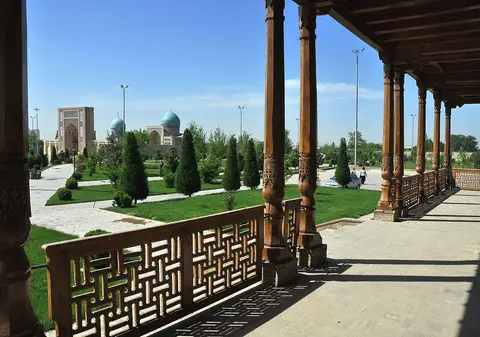
A religious ensemble in the old town that survived the 1966 earthquake. It includes the Tillya Sheikh Mosque, the Kaffal Shashi Mausoleum and the Barak Khan Madrasah, and the 7th-century 'Quran of Osman' manuscript is kept in the library of the Muyi Muborak Madrasah. Women are advised to cover shoulders, back and legs.
Chorsu Bazaar
A huge market known since the Middle Ages, formed around the 10th century where four trading streets met. The food pavilion under the blue dome sells dried fruit, spices and dairy products (katyk, kurt, suzma), and nearby food stalls serve plov, kebab and samsa. Ceramics, national clothing and other souvenirs are plentiful.
A 16th-century madrasah a couple of minutes on foot from Chorsu Bazaar, whose 20-metre portal is decorated with majolica tiles. It is still a working religious school. The neighbouring Gulbozor street has been turned into a tourist street with craft workshops and a 'History of Bread' exhibition.
Amir Temur Square & State Museum of Temurids History
Temur's equestrian statue in the middle of the square bears the motto 'Strength is in justice' in four languages. The museum next door opened in 1996 and has an 8.5-metre crystal chandelier and more than 3,000 exhibits. Check hours and prices officially.
State Museum of History of Uzbekistan
Opened in 1876, one of the first museums in Central Asia, with more than 250,000 objects from the Stone Age to the present. A 1st-century Buddha statue found in Surkhandarya is a highlight. Check hours and prices officially.
State Museum of Applied Arts
Started in 1927 as a handicrafts exhibition, it holds more than 7,000 works from the early 19th century to today: ceramics, jewellery, gold embroidery, suzani, carpets, skullcaps and more.
Tashkent Metro stations
Every station was decorated by different architects and artists with mosaics and traditional patterns, earning it the name 'underground art gallery'. The Alisher Navoi and Paxtakor transfer stations even have a reading room and library.
Minor Mosque
A white marble mosque on the bank of the Ankhor river, opened in 2014, with room for more than 2,500 people. Avoid shorts, T-shirts and skirts, women should cover their heads, and visit outside prayer times.
Uzbekistan's signature dish of rice, meat, carrots, onions and spices, inscribed on UNESCO's Intangible Cultural Heritage list in 2016. Tashkent makes a festive version called 'Bayram Osh'.
Samsa
A pastry baked in a clay tandoor oven, usually filled with minced meat, sometimes with pumpkin, spinach or potato.
Lagman
Hand-pulled noodles topped with a lamb and vegetable sauce. Varieties include chuzma lagman with stretched noodles and kovurma lagman with fried noodles.
Non (Uzbek flatbread)
Crisp, fragrant bread baked in a tandoor and a symbol of goodness and well-being; guests are traditionally welcomed with hot bread and tea.
Manti
Large dumplings of minced meat in thin dough, steamed in a tiered pot and served with suzma, a fermented milk product.
Green tea culture
Green tea is the favourite in Uzbekistan. Hosts pour the tea into a bowl and back into the pot three times, then serve the fourth pour a sip or two at a time as a sign of respect.
Daily budget (per person)
BudgetTransport: UZS 1,700 per metro or bus ride (ATTO or contactless card), UZS 3,000 for a cash QR ticket. Hotel and food costs vary by date; check booking sites
Mid-rangeWith taxis: use an official taxi app, as the tourism site advises (check fares officially). Check booking sites for hotels and food
ComfortAccommodation is most of the budget; compare prices for your dates on booking sites
Amounts are rough figures in local currency. Check exchange rates before you go.
Sample itinerary
Day 1
Khazrati Imam complex → Chorsu Bazaar for browsing and lunch (plov, samsa) → Kukeldash Madrasah and the Gulbozor tourist street → metro to Amir Temur Square, looking at the stations on the way.
Day 2
State Museum of Temurids History → State Museum of History → State Museum of Applied Arts → Minor Mosque on the Ankhor river → an evening walk on Taras Shevchenko Street.
Local tips
Entry rules depend on your nationality. Check the Uzbek government's official information (e.g. e-visa.gov.uz) before you travel. According to the tourism site, hotels and guesthouses register foreign guests; check the conditions officially.
In mosques avoid shorts, T-shirts and skirts, and women should cover their heads. Don't take photos during prayers, and ask before photographing people in the street. Drinking alcohol in public places and smoking outside designated areas are prohibited.
Flying a drone requires prior permission from the Civil Aviation Agency or other authorities; unauthorised use can lead to fines or confiscation.
Emergency numbers: unified number 112, police 102, ambulance 103, fire 101. The tourist safety call center is 1173, and Tashkent has tourist police to help foreign visitors.
During summer 'chillya' (late June to early August), avoid midday walks and drink plenty of water. Don't drink untreated tap or open water.
You can change money at hotels, banks and exchange offices. The time zone is UTC+5. Check your government's current travel advice for Uzbekistan before you go.