Elsewhere in the country: Level 3 (leave the country) — some regions: L3 (leave): Chiapas, Sinaloa / L2: rest of the country / special advisory: Guanajuato
Visits to the listed regions should be cancelled or postponed (see Details for other areas).
checked 2026-10-05 · Details ↗ This is the Korean government’s advisory — also check your own government’s travel advice.
Cancún Travel Guide
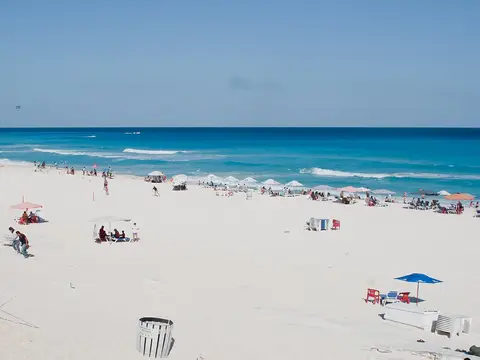
A resort city in Mexico's Quintana Roo state, known for the roughly 22 km of Hotel Zone beaches and the turquoise Caribbean Sea. The Hotel Zone itself holds Maya ruins such as El Rey and the Maya Museum, and the city is a handy base for a ferry to Isla Mujeres and day trips to Tulum, Cobá and Chichén Itzá.
According to Quintana Roo's tourism board, the climate is warm and humid with an annual average of about 26°C, average highs of about 33°C in summer and average lows of about 17°C in January. The rainy season runs May–October, and Mexico's disaster prevention center (CENAPRED) says the Atlantic tropical cyclone (hurricane) season starts on 1 June. If you travel then, check weather warnings and your government's travel advice before you go.
Airport to the city
Cancún International Airport (CUN): ADO bus
According to the airport operator ASUR, the ADO shuttle runs to the city from Terminals 2, 3 and 4. The tourism board says the airport is about 16 km from the Hotel Zone and about 20 km from downtown. Check routes and timetables with ADO.
Time check official infoCost check official info
Cancún International Airport (CUN): Taxi
According to ASUR, taxi service is available at Terminals 2 and 3. Korea's Ministry of Foreign Affairs advises using a taxi called through your hotel rather than hailing one on the street, keeping windows closed and bags on the floor.
Time about 16 km to the Hotel Zone (depends on traffic)Cost check official info
Tren Maya: Cancún Airport station
Maya Train services toward Playa del Carmen, Tulum Airport, Mérida and Chetumal leave from Estación Cancún Aeropuerto. Since 15 August 2026 the 'Tren Maya Conecta' intermodal service has linked stations with the airport, the hotel zones and other points. Better for regional trips than for getting into the city.
Time ~49 min to Playa del CarmenCost check official info (trenmaya.gob.mx)
Getting around
City buses & Hotel Zone addresses
The tourism board says city buses cover most of the city and tourist spots with frequent, affordable service. Hotel Zone addresses are given as kilometre points on Bulevar Kukulcán (El Rey at km 18, the Maya Museum at km 16), which makes stops easy to find. Check fares locally.
Taxis
Korea's Ministry of Foreign Affairs recommends a call taxi arranged by your hotel over street taxis, and notes that app-based ride services are hard to use in some resort areas such as Cancún. Ask your hotel how best to get around.
Ferries to Isla Mujeres
Ferries, including Ultramar, leave from Puerto Juárez and from Playa Tortugas (Bulevar Kukulcán km 6.5) and Playa Caracol (km 9.5) in the Hotel Zone; the tourism board puts the crossing at about 20 minutes. The operator asks you to arrive 30 minutes before departure, and the pier fee is not included in the fare. Check fares and schedules officially.
Tren Maya (regional trains)
Since 15 August 2026 the Cancún–Playa del Carmen route runs four trips a day (from Cancún 06:45 and 10:30; from Playa del Carmen 07:47 and 12:00). Trains also run Cancún–Tulum Airport, Cancún–Mérida and Cancún–Chetumal (about 5 h 15 min). Buy tickets on the official site, app or at ticket offices; timetables can change, so check officially.
Where to stay
Hotel Zone (Zona Hotelera)
Good for: Beaches, first-timers
According to the tourism board, about 22 km of beaches line this strip. El Rey, the Maya Museum and the Isla Mujeres ferry piers (Playa Tortugas and Caracol) all sit along Bulevar Kukulcán.
Downtown (Centro)
Good for: Bus terminal, Puerto Juárez ferry
The city proper, about 20 km from the airport; the tourism board lists the Cancún bus terminal as a main arrival point. Ferries to Isla Mujeres leave from Puerto Juárez north of downtown, and El Meco lies in the same direction.
Isla Mujeres
Good for: Quiet island stays, beaches
An island about 20 minutes from Cancún by ferry. The tourism board names Playa Norte as its signature beach, and many visitors explore the island by golf cart.
Hotel Zone beaches (Playa Delfines, Tortugas, Marlin)
The tourism board calls Playa Delfines one of Cancún's largest and most beautiful beaches, ideal for swimming and sunbathing, and suggests Playa Tortugas for something calmer. Playa Marlin is tucked behind shopping centers and resorts.
El Rey Archaeological Zone
A Maya site at km 18 of Bulevar Kukulcán, right in the Hotel Zone. It flourished most in the Late Postclassic (1200–1550), and its name ('The King') comes from a sculpture found in 1909. INAH lists it as open daily 8:00–17:00, with entry MXN 145 for foreign visitors.
An INAH museum at km 16 of Bulevar Kukulcán showing finds from Quintana Roo and the wider Maya area; the same ticket covers the San Miguelito archaeological site. Open Tuesday–Sunday 9:00–18:00 (last entry to the halls 17:00, to the site 16:30); MXN 210 for foreign visitors, free for over-60s and under-13s. Closed on Mondays.
El Meco Archaeological Zone
A site at km 2.7 of the Puerto Juárez–Punta Sam road, north of downtown Cancún. Its 'El Castillo' is the tallest building in the region, with views over Cancún island. Open daily 8:00–16:30; MXN 145 for foreign visitors. The tourism board notes it gets fewer visitors than the Hotel Zone sites.
Isla Mujeres
An island about 20 minutes from Cancún by ferry. The tourism board highlights Playa Norte and Punta Sur at the southern tip, with a shrine to the Maya goddess Ixchel; from May to September you can join tours to swim with whale sharks.
Tulum archaeological site (day trip)
A walled Maya city on the Caribbean shore about 128 km south of Cancún, crowned by its tallest building, El Castillo. INAH lists hours of 8:00–17:00 (last entry 15:30) and a unified fee of MXN 265 for foreign visitors, including CONANP and other charges.
A UNESCO World Heritage Site famous for the play of light and shadow on the staircase of El Castillo at each equinox. INAH lists it as open daily 8:00–16:00; the fee is MXN 105 (INAH) plus a separate Yucatán state fee of MXN 592 for foreign visitors, sold at the site ticket office. The Tren Maya route has a Chichén Itzá station; check timetables officially.
From Cancún take Highway 307 south to Tulum, then Highway 109 for about 47 km. INAH lists it as open daily 8:00–17:00 (last entry 16:00), MXN 210 for foreign visitors. The Nohoch Mul pyramid is open 8:00–15:30 in groups of up to 15, with a maximum of 15 minutes at the top.
Pork marinated in achiote and sour orange, wrapped in banana leaves and slow-cooked in an earth oven (pib). Usually served in tacos or tortas with pickled red onion and habanero.
Papadzules
Soft corn tortillas filled with chopped boiled egg, topped with pumpkin-seed sauce and tomato sauce; one of the oldest recipes of the Yucatán Peninsula.
Sopa de lima
A Yucatecan chicken broth with the juice of the fragrant local lima and strips of fried tortilla.
Poc chuc
Thin slices of pork marinated in sour orange juice and grilled over charcoal, served with pickled red onion and roasted tomato salsa.
Tikin xic
Fish rubbed with achiote, wrapped in banana leaf and grilled, as prepared across the Yucatán Peninsula.
Daily budget (per person)
BudgetEntry fees: El Rey MXN 145, Maya Museum MXN 210 (includes San Miguelito; foreign-visitor rates) — sticking to beaches and city buses keeps transport cheap. Hotel and food costs vary a lot by date; check booking sites
Mid-rangeDay-trip sites: Tulum MXN 265, Cobá MXN 210, Chichén Itzá MXN 105 + Yucatán state fee MXN 592 (foreign-visitor rates). Check train, bus and ferry fares officially
ComfortAccommodation is most of the budget — compare prices for your dates on booking sites, and allow for restaurant tips (about 10–15% of the bill)
Amounts are rough figures in local currency. Check exchange rates before you go.
Sample itinerary
Day 1
Maya Museum and San Miguelito in the morning (closed Mondays) → bus to El Rey (open until 17:00) → afternoon on Playa Delfines.
Day 2
El Meco first thing (opens 8:00) → ferry from Puerto Juárez to Isla Mujeres (~20 min) → Playa Norte and Punta Sur → evening ferry back to Cancún. Allow a separate day each for Tulum/Cobá or Chichén Itzá.
Local tips
Korea's Ministry of Foreign Affairs has most of Mexico, including Quintana Roo where Cancún is, at travel alert level 2 (reconsider travel); Chiapas and Sinaloa are at level 3 and Guanajuato has a special advisory. Check your government's current travel advice before you go.
Check entry requirements on official Mexican government and embassy sources before you travel. Cancún uses UTC-5 (Southeast Time) all year, with no daylight saving.
The official currency is the Mexican peso (MXN). The tourism board says most tourist spots accept major cards and US dollars, but recommends always carrying pesos. Tips are usually 10–15%.
The tourism board asks you not to wear sunscreen, even biodegradable, in the water where there is marine life — wear a rash guard instead. For other outdoor activities it recommends biodegradable sunscreen and insect repellent.
Korea's Ministry of Foreign Affairs advises using call taxis arranged through your hotel rather than street taxis, avoiding eye-catching jewellery and not going out alone where possible.
Emergency: 911 (police, fire and ambulance). Tourist information and roadside help: 078 (Ángeles Verdes, Ministry of Tourism, free).