Korean MOFA travel advisory: Your destination: Level 1 (exercise caution) · some areas of the country have advisories

Elsewhere in the country: Level 1 (exercise caution) — some regions: Special advisory: Tibet, Xinjiang Uyghur AR / L1: rest of the country

checked 2026-10-05 · Details ↗ This is the Korean government’s advisory — also check your own government’s travel advice.

Harbin Travel Guide

The capital of Heilongjiang Province in northeast China, nicknamed the “Ice City”. European-style buildings on Central Street, laid out from 1898, and the Byzantine-style Saint Sophia Cathedral, first built in 1907, give the streets a distinctly foreign feel, and winter brings ice and snow events such as Harbin Ice and Snow World and the Sun Island snow sculpture expo. Ideal for winter festivals, historic architecture walks and northeastern Chinese food.

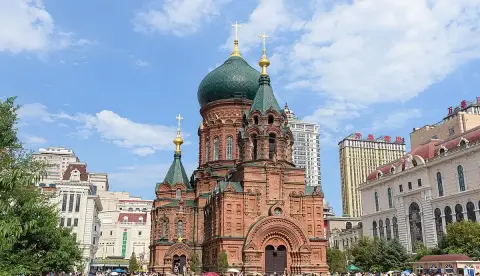
The west facade of Harbin's Byzantine-style Saint Sophia Cathedral.
Saint Sophia Cathedral, Harbin · Photo: N509FZ / CC BY-SA 4.0

Plan your Harbin trip

We never take payment — compare, then book on the official partner site.

At a glance

Currency
CNY (¥)
Power & plugs
220V · Type A/C/I
Driving side
Right
Tipping
Not expected
Local language
中文(简体)
How long to stay
3 to 4 days

Emergency numbers

When to go

Winter is the season for ice and snow sights. Harbin Ice and Snow World and the Sun Island snow sculpture expo open only in winter, and the China Harbin International Ice and Snow Festival is held every winter. Check each season's official announcement for opening dates. Winter temperatures are given as -20 to -30°C, so prepare for serious cold. Summer averages 18-22°C, and Harbin is also promoted as a cool summer escape.

Monthly climate normals

High °CLow °CRain mm
Jan-13.0°-24.6°3
Feb-8.5°-21.3°6
Mar2.0°-10.2°10
Apr13.3°0.0°21
May21.3°7.6°37
Jun26.0°14.0°78
Jul27.7°18.0°153
Aug26.1°16.1°116
Sep20.5°8.5°61
Oct11.7°-0.1°23
Nov-0.3°-10.5°8
Dec-9.8°-20.3°5

Monthly averages of daily highs and lows, and average monthly rainfall. Any given year can differ.

Source: WMO World Weather Information Service — China Meteorological Administration · Harbin (WMO city data) · reference period not stated by the source —View source

Airport to the city

Airport bus

Several airport bus routes run from Harbin Taiping International Airport (HRB) into the city; timetables are published on the airport's official WeChat account. Harbin Ice and Snow World's official transport guide also lists Airport Bus Line 4 among the routes serving the park.

Time check official infoCost check official fares

Metro

As of a January 2024 reply from Harbin Metro Group, a metro line to the airport was still at the planning stage. Check Harbin Metro's official information for whether it has opened.

Time check official infoCost check official fares

Taxi or ride-hailing

Harbin Ice and Snow World's official transport guide puts the airport about 39 km and roughly 50 minutes by road from the park. Handy with heavy luggage or late arrivals; have your hotel address in Chinese.

Time depends on trafficCost metered (check official info)

Getting around

Metro

Lines 1, 2 and 3 form a cross plus a loop. Line 2 has Central Street, Sun Island and Ice and Snow World stations, and Saint Sophia Cathedral is a short walk from Shangzhi Dajie station. Line 3 serves Stalin Park (about 10+ minutes' walk from Youyigong station) and the Chinese Baroque district (Zhonghua Baluoke Jiequ station).

City buses

A wide network; for example, routes 29, 42, 43 and 47 among others stop at Harbin Ice and Snow World.

Walking

From Saint Sophia Cathedral to Central Street is about 15 minutes on foot via Zhaolin Street and Shitou Daojie. The Flood Control Memorial Tower stands at the north end of Central Street, and the Songhua River sightseeing cableway is about 12 minutes from there along Stalin Street.

Taxis and ride-hailing

Harbin Ice and Snow World's official guide gives a reference fare of about CNY 20 from the park to Central Street. Showing your destination in Chinese helps.

Where to stay

Central Street and Saint Sophia (Daoli District)

Good for: First visit, historic architecture, night views

Central Street's European-style buildings, Saint Sophia Cathedral, the Flood Control Memorial Tower and Stalin Park on the Songhua River are all within walking distance. Especially atmospheric when lit up at night.

Songbei District (Sun Island and Ice and Snow World)

Good for: Winter ice and snow events, riverside nature

Home to the Sun Island Scenic Area and, on its west side, Harbin Ice and Snow World. Metro Line 2 runs straight there from the city center.

Chinese Baroque historic district (Daowai District)

Good for: Old streets, food, photography

The oldest part of modern Harbin, with the largest and best-preserved group of Chinese Baroque buildings still standing in China. Get off at Zhonghua Baluoke Jiequ station on Metro Line 3.

Map of stays in Harbin

Compare prices from many booking sites on the map

Search stays in Harbin in the app

Map & prices: Stay22 — you book on each site

Top sights

  1. Central Street (Zhongyang Dajie)

    Laid out from 1898 and first called China Street, it took its current name in 1925. The 1,450 m long, 21.34 m wide street is lined with 75 European and European-style buildings in Renaissance, Baroque, eclectic and Art Nouveau styles, and even its "bread loaf" cobblestones date back over a century. Get off at Central Street station on Metro Line 2.

  2. Saint Sophia Cathedral

    A Byzantine-style Orthodox church first built in 1907 and Harbin's signature landmark. At night golden lights outline the dome. The address is 88 Toulong Street, Daoli District, and Central Street is about 15 minutes' walk away. Check official information for hours and fees.

  3. Songhua riverside and Stalin Park

    A long open-air park on the south bank of the Songhua River, known for its five-color flower beds, sculptures and European-style garden design. Nearby are the Flood Control Memorial Tower, built in 1958 to mark the city's victory over the 1957 flood; the Songhua River sightseeing cableway, giving 360-degree views of the river and city from over 70 m up; and the old Binzhou railway bridge, where glass panels let you look down on the century-old structure.

    The old Binzhou Railway Bridge spanning the Songhua River in Harbin.
    Binzhou Railway Bridge over the Songhua River · Photo: Thyristorchopper / CC BY-SA 3.0
  4. Sun Island Scenic Area

    China's largest urban riverside eco-area, rated a national 5A scenic area and a national wetland park; the traditional Sun Island zone alone covers 7.05 sq km. In winter it hosts the Sun Island International Snow Sculpture Art Expo, with tickets bookable through the scenic area's official WeChat account. Check official information for hours and fees.

    Sun Island Scenic Area in Harbin in early summer.
    Sun Island Scenic Area, Harbin · Photo: Yumeto / CC BY-SA 4.0
  5. Harbin Ice and Snow World (winter season)

    A large-scale ice and snow art project launched by the Harbin Municipal Government in 1999, on the west side of Sun Island. The outdoor ice park opens only in winter; check the official site (ice.hrbicesnow.com) each season for opening dates and ticket prices. The indoor Dream Ice and Snow Hall, kept at -8 to -12°C, shows ice sculptures outside winter too. Get off at Ice and Snow World station on Metro Line 2.

  6. Heilongjiang Siberian Tiger Park

    Described as the world's largest breeding base for Siberian (Amur) tigers. Walk along the tiger-viewing corridor or ride a sightseeing vehicle to watch tigers feeding up close, and there is an area for tiger cubs. Check official information for hours and fees.

  7. Chinese Baroque historic district

    One of Harbin's protected historic districts, with the largest and best-preserved Chinese Baroque buildings still standing in China. Old courtyards and alleys, food and folk culture survive side by side; allow about half a day to explore.

Tours & tickets →

What to eat

Guobaorou

Named by the Heilongjiang Department of Culture and Tourism among the signature foods of a Harbin trip.

Harbin red sausage (hongchang)

A Harbin signature whose making technique is presented as intangible cultural heritage. Lean pork and beef are seasoned with spices, then boiled twice and smoked twice over hardwood, giving a date-red skin. Eat it as is, stir-fried or grilled.

Dalieba (big bread loaf)

A large loaf listed among Harbin's specialty foods and also presented as one of Central Street's long-established treats.

Freshly brewed kvass (gewasi)

A drink that appears on the same list of Harbin specialty foods.

Suancai jiaozi (pickled cabbage dumplings)

Dumplings listed among Harbin's specialty foods; a steaming plate is perfect on a snowy day.

Tieguo dun (iron-pot stew)

A country-style stew cooked in an iron pot, on the list of Harbin specialty foods.

Daily budget (per person)

BudgetBudget travel with cheap lodging, local eateries and the metro (strolling Central Street and the open-air Stalin Park needs no ticket)
Mid-rangeCity hotel, restaurants, taxis and entry fees (Ice and Snow World and snow expo prices are announced each season; taxi from Ice and Snow World to Central Street about CNY 20 for reference)
ComfortUpscale hotel, banquet-style meals and a car with driver (check prices with providers)

Amounts are rough figures in local currency. Check exchange rates before you go.

Sample itinerary

  1. Day 1

    Saint Sophia Cathedral in the morning, a walk along Central Street, the Flood Control Memorial Tower and Stalin Park in the afternoon, the Songhua River sightseeing cableway around sunset, then guobaorou for dinner.

  2. Day 2

    Siberian Tiger Park in the morning, Metro Line 2 to Sun Island, then in winter enter Ice and Snow World around 15:30-16:00 to see it in daylight and lit up after dark; red sausage and dalieba in the evening.

Local tips

Related articles

All articles →

Prices and times are approximate as of 2026-09 and may change. Always re-check visa and entry rules with official sources before you travel.

More city guides