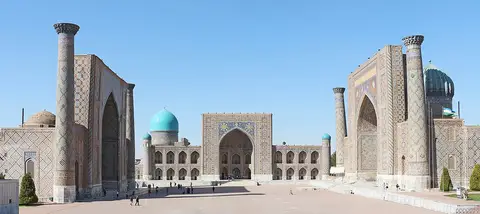
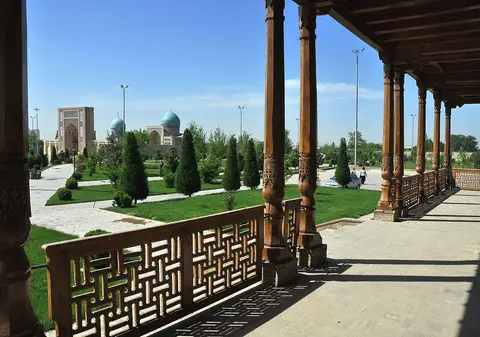
Founded about 2,750 years ago, this Silk Road hub was the capital of Amir Temur's empire. Listed by UNESCO as 'Samarkand – Crossroads of Cultures', it gathers blue-tiled monuments such as Registan Square, Gur-Emir, the Bibi-Khanym Mosque and Shah-i-Zinda in its old town.
Uzbekistan's national tourism site calls spring and autumn the 'velvet season', the best time to travel. Samarkand's winters are usually mild and rarely drop below 0°C, but nights can be chilly, so bring a sweater and scarf. Summers are very hot, and from around 20 June to early August comes 'chillya', the 40 hottest days, so carry a hat, sunglasses and water. Navruz, the spring holiday, falls on 21 March every year.
Airport to the city
Samarkand International Airport (SKD): taxi
The airport is on Ibn Sino Street in Samarkand city. The operator's official page gives no city transport details. According to Uzbekistan's national tourism site, taxis can be ordered via official taxi apps in Samarkand, and it advises using them to avoid overpricing.
Time check official infoCost check official info
Samarkand International Airport (SKD): minibuses & city buses
The tourism site says minibuses and taxis are commonly used to reach airports and railway stations in Uzbekistan. There is no official information on route numbers or hours from the airport to the city, so check locally.
Time check official infoCost check official info
Arriving via Tashkent (TAS): Afrosiyob high-speed train
According to Uzbekistan Railways, the Afrosiyob high-speed train began running between Tashkent and Samarkand on 8 October 2011. It covers 344 km with a top speed of 250 km/h. Buy tickets with your passport details on the railway's booking site (eticket.railway.uz).
Time ~2 h 15 min (per Uzbekistan Railways; check the current timetable)Cost check official info (fares by date and class on the booking site)
Getting around
Walking the old town
Registan Square, Gur-Emir and the Bibi-Khanym Mosque are all in the historic centre, and Siab Bazaar is right next to the Bibi-Khanym Mosque. There is little shade at midday in summer, so walk early in the morning or in the evening.
Taxi (official apps)
The tourism site says taxis can be ordered via official taxi apps in Samarkand and recommends them to avoid overpricing. Check fares officially.
City buses & minibuses
According to the tourism site's general information for Uzbekistan, a city bus ride costs UZS 1,700 and tickets can be bought from the conductor on board. Fares may differ by city, so check locally. Minibuses are popular for long cross-city trips.
Afrosiyob high-speed train (to Tashkent and Bukhara)
The tourism site says the Afrosiyob links Tashkent, Samarkand, Bukhara and other cities, and the standard traveller's route is Tashkent → Samarkand → Bukhara by train, then a bus to Khiva. Book ahead in peak season. Uzbekistan Railways says passenger details must match your ID (passport).
Where to stay
Around Registan Square (historic centre)
Good for: First-timers, sightseeing
The heart of the historic centre, with Registan Square and the Gur-Emir Mausoleum. According to official announcements the Registan stays open late, so it is good for night views too.
Around Siab Bazaar & the Bibi-Khanym Mosque
Good for: Bazaar browsing, souvenirs
Siab Bazaar sits next to the Bibi-Khanym Mosque in the middle of the old town, selling dried fruit, nuts, sweets, Samarkand bread and halva.
Orzu Mahmudov Street
Good for: Late dinners
According to a September 2026 announcement by the Registan directorate, this service street was created under Samarkand's '24/7 tourism' policy, with 20 eateries serving Uzbek and international food around the clock.
Samarkand's main square, whose name means 'sandy place', framed by three madrasahs: Ulugbek, Sherdor and Tilla-Kari. The Ulugbek Madrasah was built in 1417-1420, and the Sherdor ('abode of lions') Madrasah, famous for the beast chasing a deer on its portal, in 1619-1636. Officially open daily, 07:00-24:00 from 20 February to 20 November and 08:00-20:00 from 20 November to 20 February. E-tickets are sold on the official site (tickets.registon.uz).
Gur-Emir (Amir Temur Mausoleum)
The royal tomb of the Temurids, where Amir Temur, his mentor and members of his family are buried. Temur began building it in 1403 for his grandson Muhammad Sultan, and it was completed under Ulugbek. Temur's famous dark green jade tombstone lies in the middle of the main hall.
The great mosque built on Temur's orders in 1399-1404, then the largest mosque in Central Asia. It is named after Temur's beloved wife, Saray Mulk Khanym, and its 5,000-square-metre courtyard is surrounded by tall minarets on four sides.
The market right next to the Bibi-Khanym Mosque, in the middle of the old town. It is full of dried fruit, nuts and sweets, and Samarkand bread and halva are its specialities. As of a September 2026 announcement, it stays open until midnight.
Shah-i-Zinda Necropolis
One of Central Asia's most revered pilgrimage sites, associated with Qusam ibn Abbas, a cousin of the Prophet Muhammad. Its mausoleums, decorated with blue and turquoise tiles, date from the 11th to the early 20th century. It is a place of pilgrimage: visit quietly, and women are advised to cover shoulders, back and legs.
The medieval observatory built near Samarkand in 1428-1429 by Ulugbek, Temur's grandson and an astronomer. It was a round three-storey building 46.4 m across; today part of its huge marble quadrant, reaching underground, survives. Its star catalogue described 1,018 stars.
Ancient Settlement of Afrasiab
One of Central Asia's key archaeological sites, in the north of the city, dating back to the 8th century BC. Excavations found palaces, nobles' houses, mosques, baths and Samanid-era cobbled streets. The Samarkand State Museum-Reserve also runs a Museum of the History of Samarkand and Afrasiab.
Imam al-Bukhari Memorial Complex (day trip)
The resting place of the hadith scholar Imam al-Bukhari, in Chelak district about 25 km from Samarkand. A mausoleum and mosque in traditional style were built over the grave; the mausoleum is topped by a 17-metre dome. It is a religious site, so dress and behave respectfully.
Uzbekistan's signature dish of rice, meat, carrots, onions and spices, inscribed on UNESCO's Intangible Cultural Heritage list in 2016. In Samarkand style it is not stirred while cooking, so each diner can choose how much carrot and meat to take.
Samarkand non (bread)
Tandoor-baked Samarkand bread is so famous that legend says it never goes hard however long it is kept. Samarkand uses vertical tandoors.
Kebab
The tourism site says various kebabs are popular in Samarkand alongside plov.
Manti
Large dumplings of minced meat in thin dough, steamed in a tiered pot. They are served with suzma, a fermented milk product that Samarkand calls 'chakka'.
Dried fruit, nuts & halva
Siab Bazaar is packed with dried fruit, nuts and sweets, and Samarkand halva is especially well known. Good for souvenirs too.
Green tea culture
Hot tea follows every meal. Before serving a guest, the host pours tea into a bowl and back into the pot three times, then serves the fourth pour.
Daily budget (per person)
BudgetTransport: walking the old town and taking city buses (UZS 1,700 per ride per the tourism site's general information) keeps costs low. Check monument entry fees officially; hotel and food costs vary by date, so check booking sites
Mid-rangeWith taxis: use an official taxi app, as the tourism site advises (check fares officially). Check Afrosiyob fares to and from Tashkent on the booking site
ComfortAccommodation is most of the budget; compare prices for your dates on booking sites
Amounts are rough figures in local currency. Check exchange rates before you go.
Sample itinerary
Day 1
Registan Square (the three madrasahs) in the morning → Gur-Emir → Bibi-Khanym Mosque → lunch at Siab Bazaar (plov, bread) → Shah-i-Zinda in the afternoon → back to the Registan at night (a music show daily at 21:00, per a September 2026 announcement).
Day 2
Ancient Settlement of Afrasiab and its history museum → Ulugbek Observatory → afternoon trip to the Imam al-Bukhari Memorial Complex (~25 km) → dinner on Orzu Mahmudov Street.
Local tips
Entry rules depend on your nationality. Check the Uzbek government's official information (e.g. e-visa.gov.uz) before you travel. According to the tourism site, hotels and guesthouses register foreign guests; check the conditions officially.
In mosques and mausoleums avoid shorts, T-shirts and skirts; women should cover shoulders, back and legs, and cover their heads. Don't take photos during prayers, and ask before photographing people.
Afrosiyob tickets sell fast in peak season, so book ahead. Uzbekistan Railways says passenger details must be entered exactly as in your passport.
According to a September 2026 Samarkand announcement, the Afrasiab Museum, Gur-Emir, Bibi-Khanym and the Ulugbek Observatory museum stay open until 23:00 and the Registan until 24:00. Hours can change, so check locally.
Emergency numbers: police 102, ambulance 103, fire 101. The tourist safety call center is 1173, and Samarkand has tourist police to help foreign visitors. Drones need prior permission and are prohibited near historical landmarks without it.
During summer 'chillya' (late June to early August), avoid midday walks and drink plenty of water; don't drink untreated water. The time zone is UTC+5. Check your government's current travel advice for Uzbekistan before you go.