Comparison · South Korea
Busan vs Jeju: Which Should You Choose for a First Trip?
Busan or Jeju for your Korea trip? Getting there and airport transfers, the guides' days and daily budgets, same-month weather normals and what you do in each.

Published
The short answer
Busan is Korea's second city, where beaches, a busy port and hillside villages meet the sea. A trip centers on Haeundae and Gwangalli beaches, Gwangan Bridge lit up at night and market food at places like Jagalchi, and you get around by subway and bus.
Jeju is a volcanic island of craters, sea cliffs and emerald beaches, with South Korea's highest mountain, Hallasan, at its center. Sights are spread around the island, and driving the coast in a rental car is the most common way to explore.
Best for: Busan suits a short trip mixing sea, city, night views and markets, and anyone who prefers public transport. Jeju suits travelers who come for volcanic scenery, Olle trail walks and small islands, and who can drive.

Getting there and from the airport
Both guides describe the trip from Seoul. Busan is about 2 hours 30 minutes to 3 hours by KTX high-speed train from Seoul Station to central Busan Station; if you land at Incheon Airport, first get to Seoul Station. You can also fly into Gimhae International Airport. Jeju is about an hour by air from Seoul. Check flight options with airlines.
From Gimhae International Airport (PUS), take the Busan-Gimhae Light Rail to Sasang, then subway Line 2 toward Seomyeon and Haeundae. Haeundae takes about 1 hr-1 hr 20 min, so plan your first day around it.
On Jeju, most visitors collect a rental car near the airport. Taxis are easy for hotels in Jeju City, and airport limousine bus 600 and express buses run to Jungmun and Seogwipo. Route numbers and timetables can change, so check the official Jeju bus information site.
- Busan light rail and subway: about 30-40 min to Seomyeon, 1 hr-1 hr 20 min to Haeundae, about 1,500-3,000 won
- Busan limousine bus or taxi: about 40 min to Seomyeon, 1 hr-1 hr 20 min to Haeundae; taxi about 25,000-40,000 won (limousine fares vary by route, check official info)
- Busan KTX (Seoul Station → Busan Station): about 2 hours 30 minutes to 3 hours, about 50,000-60,000 won standard class, varies by time
- Jeju rental car: about 10-20 min to Jeju City, about 1 hr to Seogwipo (cost varies by car, dates and insurance)
- Jeju airport limousine and express buses: about 1 hr-1 hr 30 min to Jungmun or Seogwipo, about 2,000-6,000 won depending on route and distance
- Jeju taxi: about 10-15 min to old Jeju City, about 5,000-10,000 won within Jeju City
How many days, and what budget
The guides suggest 2 to 3 days for Busan and 3 to 4 days for Jeju. Jeju's sights are spread across the island, and grouping each day by direction (east, west, south) cuts driving time.
At every level the guides' daily budgets are a little higher for Jeju, and Jeju's mid-range figure includes a shared rental car. In both places, seafood is often sold at market price, so check before ordering.
- Budget: Busan about 60,000-90,000 won per day (guesthouse, subway, market food); Jeju about 70,000-100,000 won per day (guesthouse, buses, market food)
- Mid-range: Busan about 150,000-220,000 won per day (city hotel, restaurant meals, some taxis); Jeju about 180,000-250,000 won per day (hotel, shared rental car, restaurant meals)
- High-end: Busan about 350,000 won+ per day (sea-view luxury hotel, seafood feasts); Jeju about 400,000 won+ per day (resort, rental car, black pork and seafood feasts)
Weather by month, side by side
Both guides rate May-June and September-October: Busan names May-June and September-October, and Jeju names April-June and September-November. July-August is peak season in both, with rainy spells and possible typhoons.
The figures below are Korea Meteorological Administration 30-year normals for 1991–2020, from Busan station for Busan and Jeju station for Jeju. Each line shows average high / average low / monthly rainfall.
Temperatures are almost the same; rainfall differs. Busan gets more rain than its monthly average for the year in May, June and September, and less in October. Jeju gets less than its monthly average in May and October and more in June and September, when it is wetter than Busan. The wettest month is July in Busan and August in Jeju. In winter, Busan is milder than Seoul but sea winds are cold (January average low 0°C); Jeju is windy with snow on Hallasan, but it's tangerine season (January average low 4°C).
- May: Busan 22°C / 15°C / 156 mm, Jeju 22°C / 15°C / 96 mm
- June: Busan 25°C / 18°C / 188 mm, Jeju 25°C / 19°C / 171 mm
- July: Busan 28°C / 22°C / 327 mm, Jeju 29°C / 24°C / 210 mm
- August: Busan 30°C / 24°C / 267 mm, Jeju 30°C / 25°C / 272 mm
- September: Busan 26°C / 20°C / 161 mm, Jeju 26°C / 21°C / 228 mm
- October: Busan 23°C / 15°C / 80 mm, Jeju 22°C / 16°C / 95 mm
What you do there
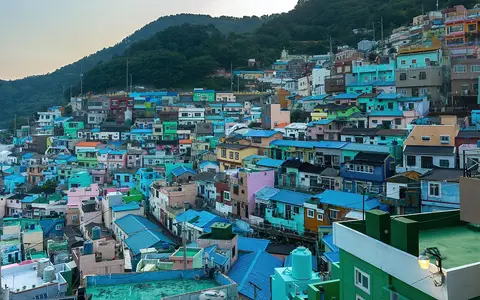
In Busan, the classics are a walk on Haeundae Beach, Gwangan Bridge lit up at night from Gwangalli, Haedong Yonggungsa Temple on seaside rocks, the hillside Gamcheon Culture Village, the clifftop Taejongdae park at the tip of Yeongdo, Jagalchi Fish Market (Korea's largest seafood market), and Gukje Market and BIFF Square. Try dwaeji gukbap (about 9,000-12,000 won), milmyeon and ssiat hotteok.
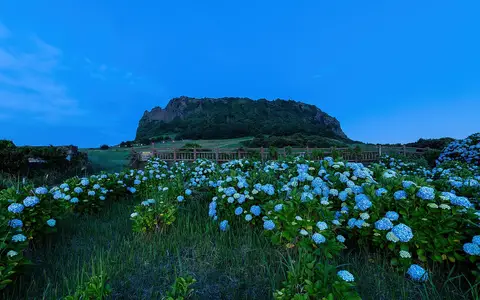
On Jeju, the highlights are Seongsan Ilchulbong (closed the first Monday of each month), Hallasan (1,950 m, South Korea's highest mountain), Udo Island about 15 minutes by ferry from Seongsan or Jongdal port, emerald Hyeopjae Beach, the Daepo Jusangjeolli Cliffs at Jungmun and Cheonjiyeon Waterfall in Seogwipo. Hallasan summit (Baengnokdam) hikes need advance reservations, and Manjanggul Lava Tube has been closed for long safety works, so check official information for opening status. Black pork barbecue and gogi guksu (about 9,000-12,000 won) are local favorites.


- Busan transit: one transit card covers the subway, buses and light rail. Subway Lines 1-4 link Seomyeon, Haeundae and Nampo-dong, and buses are handy for Gamcheon and Taejongdae.
- Busan planning: Haeundae and Nampo-dong are almost an hour apart by subway, so group sights by area.
- Jeju driving: sights are spread around the island, so a rental car is the most convenient. Foreign visitors need a valid license accepted in Korea (such as an International Driving Permit); check official rules.
- Jeju without a car: express and village buses can be infrequent, so check timetables first. Full-day taxi tours with a driver are available.
- Jeju ferries: strong winds often cancel sailings to Udo and Marado, so check on the day.
How to choose, or do both
If you'd rather not drive and want a short trip, Busan is easier: public transport takes you into the city from central Busan Station or Gimhae Airport, and the sea, night views and markets fit into 2 to 3 days. If volcanic scenery, Hallasan, Olle trails and small islands are the goal and you can drive, Jeju fits well.
To visit both, plan around each guide's suggested length. The guides don't cover travel between Busan and Jeju, so check transport options with official sources.
Korean citizens traveling domestically need no entry procedure. For foreign visitors, entry rules such as Jeju visa-free entry and K-ETA change often, so check official Korean government information before you travel.
Plan your Busan trip
We never take payment — compare, then book on the official partner site.
Plan your Jeju trip
We never take payment — compare, then book on the official partner site.
FAQ
Busan or Jeju for a first trip?
Busan if you want a short trip on public transport; Jeju if you want to drive around volcanic scenery. The guides suggest 2 to 3 days for Busan and 3 to 4 days for Jeju.
Can I visit Jeju without driving?
Yes: there are express and village buses, taxis and full-day taxi tours with a driver. Buses can be infrequent, so check timetables first; the guide calls a rental car the most convenient option because sights are spread out.
Which costs more?
The guides' daily budgets are a little higher for Jeju. Mid-range: Busan about 150,000-220,000 won per day, Jeju about 180,000-250,000 won per day.
Which months suit both?
Both guides rate May-June and September-October. In October, normal rainfall is about 80 mm in Busan and 95 mm in Jeju, below each city's monthly average for the year (Korea Meteorological Administration, 1991–2020).
Related reading
 Itinerary · South KoreaBusan in 2 Days: Gimhae Airport to Haeundae and BeyondLight rail, limousine and taxi times and fares from Gimhae Airport to Haeundae and…
 Itinerary · South KoreaJeju in 3 Days: Should You Split East and West?Jeju's sights are spread out, so cover one direction a day: a 3-day east/west plan, car…Tips · South KoreaWhich month is best for Jeju? Monthly highs, lows and rain from the climate normalsApril-June and September-November are best, and of these, April, May, October and…