Itinerary · Thailand
Chiang Rai first trip: how do you get from the airport, and how many days do you need?
Chiang Rai airport to town by taxi (about 150 THB flat) or Grab, a 4-day route with the White and Blue temples, getting around, and the cool Nov-Feb season.

Published
How many days for Chiang Rai? 3 to 4 days
Chiang Rai is Thailand's northernmost province, with layered mountain ranges and a living Lanna culture. Visitors come for its striking art temples, the all-white Wat Rong Khun (White Temple), the blue Wat Rong Suea Ten (Blue Temple) and the black buildings of Baan Dam Museum, and for the Golden Triangle, where Thailand, Laos and Myanmar meet.
The guide suggests 3 to 4 days (2 to 3 nights). Chiang Rai is smaller and quieter than Chiang Mai, good for an unhurried trip. The temples and night market in town take a day or two, but the Golden Triangle and Doi Tung are far from town, so it is easiest to set aside a separate day with a hired car.
- In town: Wat Phra Kaew, around the Clock Tower, the Night Bazaar
- Art temples: Wat Rong Khun, Baan Dam Museum, Wat Rong Suea Ten
- Further out: Doi Tung, the Golden Triangle, Hall of Opium
Airport to the city: airport taxi and ride-hailing apps
Chiang Rai's airport is Mae Fah Luang-Chiang Rai International Airport (CEI). Flights from Korea, for example, usually connect via hubs such as Bangkok. Routes and schedules change often, so check with the airline.
The airport taxi counter is by Entrance 3 on the ground floor of the terminal. The official airport site lists a flat fare within Chiang Rai city of about 150 THB; confirm it before you get in. Check the journey time into town officially.
Chiang Rai is also on Grab's official list of service areas. The fare is fixed in the app; follow the app for the airport pick-up point. You can also fly into Chiang Mai (CNX), which has more flights, and continue by intercity bus or car. The Tourism Authority of Thailand says the Green Bus takes about 3 hours; check times and fares with the operator.
- Airport taxi: counter by Entrance 3, ground floor; about 150 THB flat within the city (check official)
- Grab and other ride-hailing apps: fare shown in the app; follow the app for pick-up
- Via Chiang Mai (CNX): Green Bus about 3 hours; check times and fares officially
- Flights: usually connecting via hubs such as Bangkok; check with the airline
Getting around: ride-hailing, songthaews and tuk-tuks, a car with driver
Ride-hailing apps have fixed fares, so there is no haggling. They are handy for trips between town, the White Temple, the Blue Temple and Baan Dam.
Songthaews and tuk-tuks are good for short hops around town. There is often no fare chart, so tell the driver where you are going and agree on the fare first. The town centre around the Clock Tower, the Night Bazaar and Wat Phra Kaew are walkable. Midday is hot, so bring a hat and water.
For far-flung sights like the Golden Triangle or Doi Tung, hiring a car with driver for a half or full day is easiest. Agree on the route, hours and price first. Riding a scooter yourself requires a licence recognized in Thailand and a helmet, and accidents without a licence may not be covered by travel insurance.
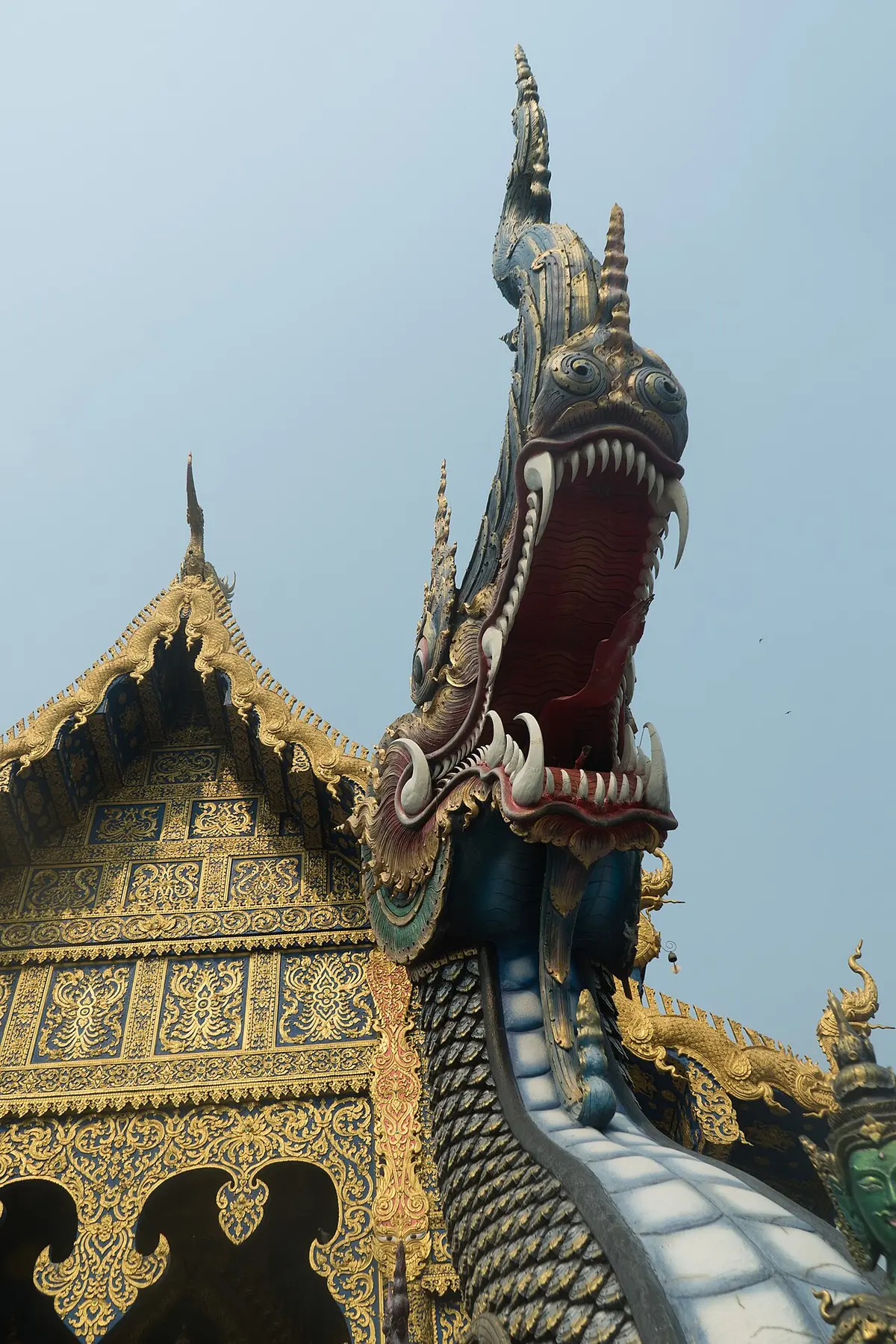
- Ride-hailing apps: fixed fares, handy between the art temples
- Songthaews and tuk-tuks: agree on the destination and fare first
- Car with driver: Golden Triangle and Doi Tung; agree on route, hours and price first
- Walking: around the Clock Tower, the Night Bazaar, Wat Phra Kaew
A basic 4-day route
On day 1, check in and spend the afternoon walking to Wat Phra Kaew, one of the oldest temples in town and once home to the Emerald Buddha, and around the Clock Tower. In the evening, try northern food such as khao soi or sai ua at the Night Bazaar. On a Saturday, a Walking Street runs along Thanalai Road from 4 pm to midnight.
On day 2, go early to Wat Rong Khun, designed and built by Lanna-art specialist Chalermchai Kositpipat; its white hall decorated with mirror pieces is the signature. Check the foreign-visitor fee and opening hours officially. Have khao soi for lunch (about 60-100 THB at local spots), then see Baan Dam Museum, created by National Artist Thawan Duchanee, with artworks in more than 25 black buildings; the Tourism Authority of Thailand lists it as open daily 09:00-17:00. Late in the day, head to Wat Rong Suea Ten, about 300 m from the Kok River Bridge.
On day 3, hire a car to see the Royal Villa and Mae Fah Luang Garden at Doi Tung, then the Golden Triangle and Hall of Opium. The road to Doi Tung is a winding mountain road, so prepare if you get car-sick. Back in town, finish with a massage. On day 4, browse the morning market and buy souvenirs, then leave town for the airport with plenty of time.

- Day 1: check in → Wat Phra Kaew and the Clock Tower area → Night Bazaar (Walking Street on a Saturday)
- Day 2: Wat Rong Khun → khao soi lunch → Baan Dam Museum → Wat Rong Suea Ten
- Day 3: hired car to Doi Tung → Golden Triangle and Hall of Opium → massage in town
- Day 4: market and souvenirs → airport (leave with plenty of time)
When to go? November to February is cool and dry
November to February is cool and dry, the best time to go, with December and January the coolest. March and April are very hot, and smoke from surrounding forest fires can make the air quality poor. May to September is the rainy season with afternoon showers but green hills, and rain drops off in October.
By the climate normals, average highs from November to February are 28-31°C, lows 14-18°C, and monthly rainfall 13-45 mm. December and January have highs of 28-29°C and lows of 14-15°C, so mornings and evenings are quite cool. In March and April, average highs reach 34-35°C, and in the rainy season August (373 mm) and July (318 mm) are the wettest.
The climate figures are 1991–2020 normals for Chiang Rai station, submitted by the Thai Meteorological Department (WMO normals collection, published by NOAA NCEI).
- November-February: highs 28-31°C, lows 14-18°C, rainfall 13-45 mm a month
- December-January: highs 28-29°C, lows 14-15°C, the coolest
- March-April: highs 34-35°C, watch for forest-fire smoke
- May-September rainy season: wettest in August (373 mm) and July (318 mm)
Where to stay, plus budget, safety and entry checks
For a first visit, the town centre around the Clock Tower is a safe choice: restaurants and places to stay cluster there, and Wat Phra Kaew and the night market are within walking distance. The Night Bazaar area suits evening strolls, and the Kok River area, close to the Blue Temple, suits quiet stays. Some travelers stay a night near the Golden Triangle and Chiang Saen and combine it with Doi Tung.
Budget about 1,000 THB per day (guesthouse, local food, songthaew), about 2,500-3,500 THB (hotel, restaurants, ride-hailing, temple fees) or about 6,000 THB+ (resort, car with driver, private tours). Carry small cash for the night market. Cover shoulders and knees at temples and take off your shoes before entering halls.
Around February to April, smoke from forest fires can make the air very poor, so check the air quality index and bring a mask if you have breathing problems. The Golden Triangle is a border area: crossing into Laos or Myanmar requires formal immigration procedures, and you should check your government's travel advice for neighbouring countries. Foreign visitors entering Thailand submit the Thailand Digital Arrival Card (TDAC) free of charge on the official site (tdac.immigration.go.th). Entry rules and procedures can change, so check Thailand's embassy or immigration website before you travel.
- Around the Clock Tower: first visit, restaurants, easy transport
- Night Bazaar area: night market, evening strolls
- Along the Kok River: quiet stays, close to the Blue Temple
- Golden Triangle and Chiang Saen: border views, a relaxed overnight
Plan your Chiang Rai trip
We never take payment — compare, then book on the official partner site.
Full Chiang Rai travel guide →
FAQ
How do I get from the airport to Chiang Rai town?
Take an airport taxi from the counter by Entrance 3 on the ground floor. The official airport site lists a flat fare of about 150 THB within the city; confirm it before you get in. Ride-hailing apps such as Grab also work.
How many days do I need in Chiang Rai?
The guide suggests 3 to 4 days. Allow two days for the temples in town and the art temples, and one day with a hired car for Doi Tung and the Golden Triangle.
How long is the bus from Chiang Mai to Chiang Rai?
The Tourism Authority of Thailand says the Green Bus takes about 3 hours. Check times and fares with the operator.
When is the best time to visit Chiang Rai?
November to February is cool and dry. By 1991–2020 normals, average highs in this period are 28-31°C and lows 14-18°C. March and April are very hot, and forest-fire smoke can make the air poor.
Related reading
 ComparisonAirport to City: Train, Bus, Taxi or Transfer? A Practical ComparisonCompare the five ways to get from the airport into town, with tips for late-night…
 ComparisonPaying Abroad: Cash vs Credit Card vs Travel Money Card — What's Cheapest?How exchange rates and card fees really work abroad, when cash still matters, and how to…
 TipsTravel Insurance Checklist: Coverage That Matters, Exclusions and How to ClaimDo you need travel insurance? What coverage matters most, how to read the exclusions,…